Thursday, July 5, 2012

The New Summer School


Video Game Design - Gamestar Mechanic


"Summer School" is a concept that for some conjures images of struggling or disengaged students battling through sweltering summer days in a school library who are trying to convince the assigned school teacher that there was just enough remediation work completed to replace a sub par grade.  Granted, that is a likely reality in a minority of circumstances, but summer school has become so much more.  One must remember, during the summer, the vast majority of summer students are choosing to spend their fleeting vacation days intentionally in a classroom.

In contrast to the teaching and learning environment during the traditional school calendar so strongly influenced by outside factors, summer school remains something of a academic laboratory for teachers and students alike.  While the expectation of learning and excellence doesn't rest in the summer, there is an opportunity to try something new, expand or improve past practice, experiment with current technologies, and attempt to connect to and build upon academic interests with less fear of embarrassment if all doesn't go as hoped.  It has become an environment where failure is recognized as an element of learning and an unavoidable side effect of the pursuit of innovation and experimentation.  The result is an increased willingness among students to engage and explore and for teachers to offer newly-created classes and learning opportunities .

Already this summer, through the coordination of our district summer school program, one that has expanded from three weeks to twelve over the last five years based on the ever-increasing student interest and participation, I have witnessed the enthusiasm of our students as they have explored interests ranging from the staples of reading and math to the enrichment opportunities of health and wellness classes, band, agriculture, robotics, graphic design, and video game creation with so much more yet to come.  I am proud of our students and teachers for their enthusiasm for learning, exploring, attempting, designing, and engaging.


Lego Robotics Programming


Lego Design Challenge


Thursday, May 24, 2012

Couldn't be more proud of our third grade team...

Schools and organizations are infinitely more successful when talented individuals are enabled and empowered to use their unique talents and strengths to achieve a shared mission and vision.  Recently I was approached by one of our outstanding teachers who had an idea.  Being a tech savvy, creative, and outgoing teacher, he saw an opportunity to teach his students how use technology to share a message that mattered, the message that bullying is destructive, hurtful, and not welcome by students at Cashton.  The idea, create a lip dub that promoted our vision and value of being a "bully free" school.  (A lip dub is a type of video that combines lip synching and audio dubbing to make a music video. It is made by filming individuals or a group of people lip synching while listening to a song or any recorded audio then dubbing over it in post editing with the original audio of the song. -thanks Wikipedia) As soon as he finished explaining to me what a lip dub was, and I heard his enthusiasm as he shared the plan, I knew the project had merit and would be a great learning experience for kids no matter how the actual project turned out.  At worst, students would learn another use of the abundant technology tools in the district and reaffirm their beliefs that bullying is not part of who we want to be.  Today I saw the end product, and I couldn't be more proud of what he, with the support of his excellent and supportive colleagues and a top-notch group of third graders, was able to teach and create even as the school year comes to a close.  Nice work, Mr. Brown!

(Wondering about the T-shirts...they were created by students in the high school innovations lab learning valuable job skills.  The text is not quite clear in the video, but the message is still strong..."Hey bully,  Who do you think you are?")


Wednesday, March 28, 2012

Ooblek - Fun or Physics?

Ooblek...have you heard of it?  I hadn't either until I discovered a group of first grade students at Cashton Elementary were planning to use the substance as part of a discovery lesson.  What group of engaged and excited six and seven year olds wouldn't be interested in non-Newtonian fluids?  Students were deep in thought as they made predictions, observations, and formed hypothesis about the bowl of strange pink...something in the front of the classroom.  Sure, it was just a basic mixture of cornstarch, food coloring, and water, but to challenge the students to understand a substance that isn't classified as a solid, liquid, or a gas certainly made for an interesting, if somewhat messy, first grade science class.


Friday, March 23, 2012

Digital Cameras and 1st Grade Geometry

Digital Geometry Scavenger Hunt
 Cashton 1st grades students were able to demonstrate their understandings of geometric shapes by finding real-world examples and taking a digital photograph.  After finding and photographing an example of each of the polygons the students had been recently reviewing, they shared the images with their teacher...no worksheets here, just a group of engaged students applying their learning and tech skills.
Formative Assessment - How did I do?

Friday, February 3, 2012

Microsoft Photo Story and Research

As I walked down the primary hallway, I noticed classrooms full of engaged and motivated students who appeared to be focused on the lesson at hand. That's not unusual, but the intense focus still piqued my interest. The topic, I discovered, included practicing the skills needed to gather information in preparation for writing a biography. Students were to use on-line and text resources to gather information about a famous individual and then present a summary of their findings using Microsoft Photo Story, a free application that allows users to create a visual story from digital photos. The value of effectively researching, summarizing, evaluating information, digital editing, and presentation were all on display, not too bad for second grade.


Thursday, January 5, 2012

Adding "Heat" to Breakfast in the Classroom

Just a little background:
In hopes of improving access to breakfast for students in the elementary, reduce costs, and improve program efficiency, the breakfast program shifted from a traditional cafeteria based program to a classroom-based program during the 2009-2010 school year.  The well-established program of the past provided a chance for students to eat breakfast for under $2.00, but participation was typically limited to 10-15% of the school population.  With the combination of reducing the price per meal to $0.50 and serving meals in the classroom setting, the goals of the transition were met.  Whether as a result of eating breakfast in the more-comfortable classroom setting with classmates or a simple price reduction, participation rates have increased to nearly 60% of the student body.  Not only do students have access to a proper and inexpensive breakfast, the combination of increased efficiency and participation made the program financially self-sufficient.

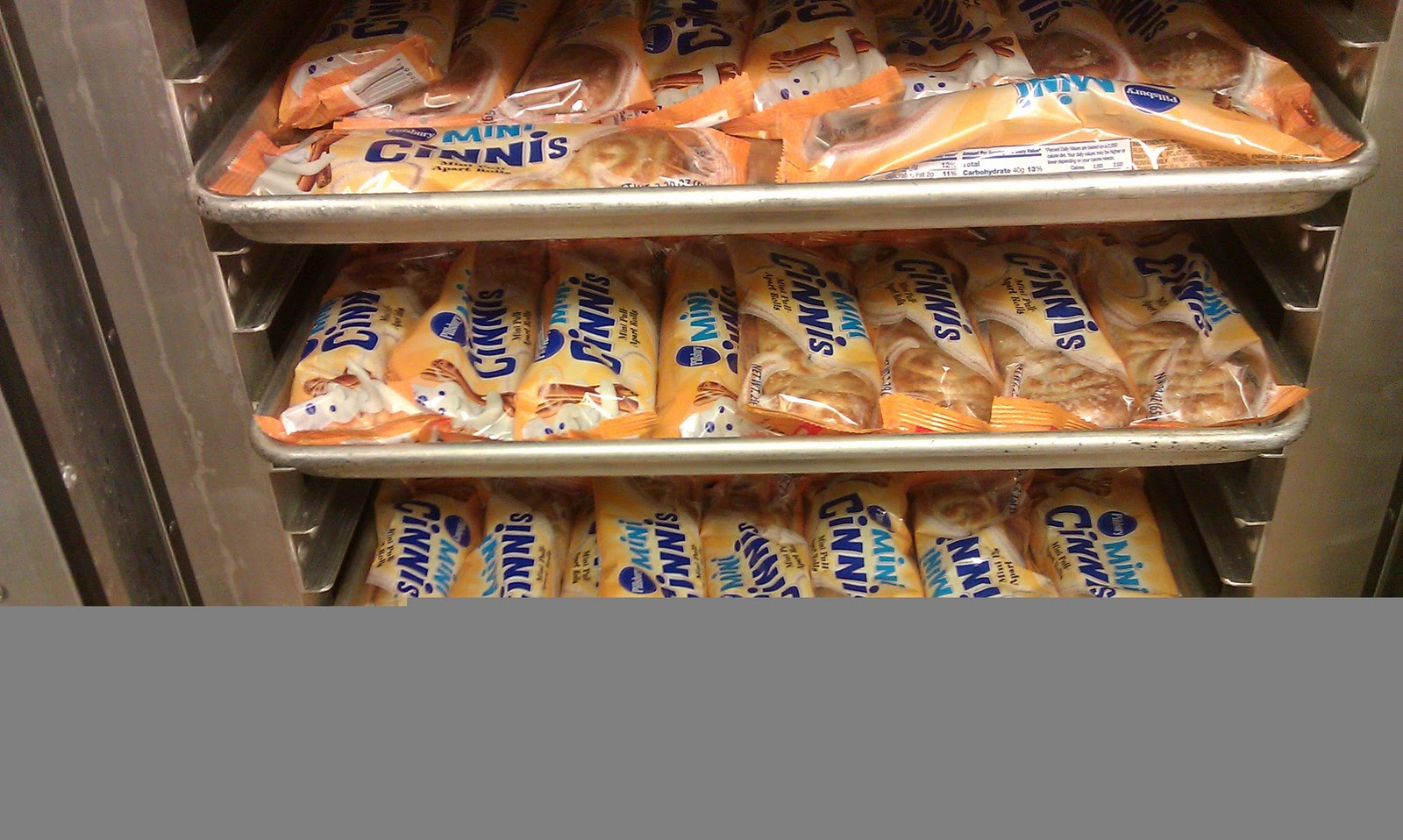
Heat and Eat Mini-Cinnis
So, what next?
Given the need for portability and food safety, menu items included a variety of pastries, fruits, cereals, and breakfast bars.  Each met or exceeded the dietary requirements and were actually well-liked by kids.  However, as our food service director continued to explore new menu items to maintain interest and variety, he discovered several products that would be popular, but really needed to be eaten warm, not for food safety purposes, rather to improve quality.  Most people don't prefer cold pancakes over warm ones.  How could we provide a warm breakfast without increasing food or labor cost?

Insulated Food Transport Bags
With the purchase of insulated food transport bags, under $15 each, we discovered that warmed breakfast items could be delivered to the classroom using the normal schedule and still be served warm to even the latest-arriving students.  Again, these items are not temperature sensitive for safety, rather satisfaction.
Proofer/Warmer
A little creativity and cooperation makes a big difference.  Kitchen staff lay out the fruit strudel, mini-pancakes, cinnamon rolls, etc. on trays the day before, a sorting practice that would happen for other items anyway.  The trays are placed in the warmer, but not yet heated.  Each are prepackaged and do not require refrigeration.  When the morning custodian unlocks the building, his one flip of a switch on the warmer makes it possible for the usual morning kitchen crew to arrive at their usual time and still be able to deliver a warm item to the classrooms.  Thanks to the cooperation and support of amazing support staff and classroom teachers always looking to improve, students can start their day with a great-tasting breakfast and the energy they need to learn and grow.